Home › News › Estadão on the set
Inside the Leavesden sets: 45,000 real books, physicist Brian Cox and magic rooted in nature
The Brazilian newspaper Estadão was among a small group of international journalists invited by HBO to visit the Leavesden sets in April 2026, and published its report on 24 November [Estadão]. Alongside new numbers on the scale of Hogwarts and Diagon Alley, the piece reveals two notable changes from the books: a four-storey office for Dumbledore already built for season 1, and wizards communicating through the aurora borealis.
Over 200 sets, 45,000 books and a running train
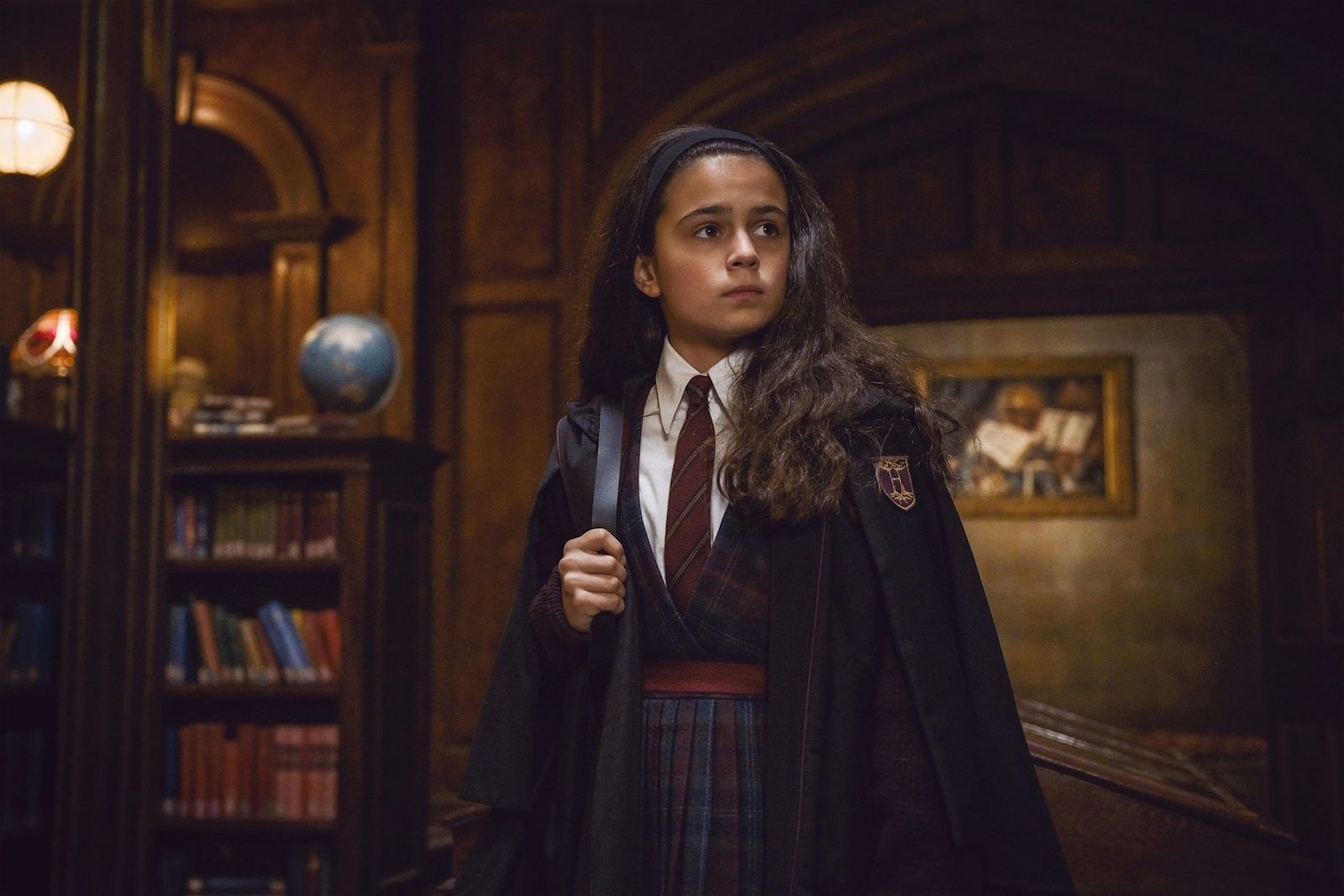
Showrunner Francesca Gardiner told the visiting reporters that more than 200 sets had already been built at Warner Bros. Studios Leavesden, with new ones still being added. Among the specifics Estadão saw first-hand:
- An interconnected Hogwarts spread across two huge stages, letting actors walk from the Great Hall through corridors to classrooms, common rooms, dormitories, staff rooms and a library holding more than 45,000 real books. That matches the book’s description of “tens of thousands of books; thousands of shelves; hundreds of narrow rows” (Philosopher’s Stone, ch. 12).
- A working Hogwarts Express running along roughly 400 metres of track connecting the Platform 9¾ set with Hogwarts station.
- Diagon Alley with more than 40 interconnected shops and practical effects, including cauldrons spewing lava, built to remain standing for seven more years.
- Practical creatures: the unicorn Harry finds in the Forbidden Forest and Ron’s rat Scabbers are animatronics built by creature effects supervisor John Nolan’s team (see also our summary of the creature department).
Two new differences from the books
The report adds two entries to our differences record, bringing the total to 34:
- Wizards communicate using the aurora borealis (Not in the books). As part of rooting magic in natural phenomena, Estadão reports that the script includes moments where witches and wizards use the aurora borealis to communicate. In Philosopher’s Stone, wizards send messages by owl post — owls “carry yer post an’ everythin’” (ch. 5) — and the aurora borealis never appears in the seven novels.
- Dumbledore’s office in season 1, four storeys tall (Different). Estadão saw Dumbledore’s office already built as a huge set of about four storeys, which was being expanded to add the headmaster’s bedroom for season 2. In Philosopher’s Stone, Harry never visits Dumbledore’s office (“They had never been told where Dumbledore lived, nor did they know anyone who had been sent to see him”, ch. 16), and when it first appears in Chamber of Secrets it is “a large and beautiful circular room” (ch. 12).
Brian Cox and magic rooted in nature
Gardiner told the journalists that the production wanted magic to feel plausible and grounded rather than like superhero visual effects:
“We kept thinking: how do we make magic feel very different from that Marvel ‘pow pow’ style, where everything is very exaggerated and you sort of don’t feel it is real when you watch? We wanted everything to feel plausible, natural and realistic.”— Francesca Gardiner to Estadão (our translation from Portuguese)
To build that naturalistic visual language, the series brought in Brian Cox, professor of particle physics at the University of Manchester, to work out how individual spells could occur in nature and what their consequences would be. Set designers drew on fractals and shell erosion, and the new Hogwarts emblem turns the letter H into a tree.
Reusing film moulds and planting later-book details
Production designer Mara LePere-Schloop and set decorator Naomi Moore acknowledged that some sets resemble the films, noting that the show shares several suppliers with the movies and reused certain moulds. “There were certain things we considered almost sacred, those that are so faithful to the book’s description, so well known, that there was no reason to erase them completely,” LePere-Schloop said, echoing director Mark Mylod’s remarks about the Great Hall.
Because all seven books are finished, LePere-Schloop added, the design team has planted canonical details in the season 1 sets that do not enter the story until the fifth or sixth book. Moore contrasted the physical sets with AI-heavy modern productions: “Our world is really a celebration of the tangible.”
Scenes seen filming on set
During reshoots on the day of the visit, reporters watched Dominic McLaughlin and Nick Frost film Harry’s first steps into Diagon Alley. In Estadão’s Portuguese report of the dialogue, Harry asks whether the street has always been there, hidden from the real world, and Hagrid answers that this is the real world — an exchange not in Philosopher’s Stone, where Hagrid simply says “‘Welcome,’ said Hagrid, ‘to Diagon Alley’” (ch. 5). The journalists also watched Arabella Stanton filming broomstick manoeuvres against a blue screen; in the book, Hermione does fly a broomstick in the winged-keys chamber near the end (ch. 16).
Estadão also confirms two points reported by Fotogramas and seen in the trailers: Harry and Draco’s first meeting takes place at Madam Malkin’s in Diagon Alley (ch. 5), and Professor McGonagall’s office was built for the series (see difference 11).
Report by Estadão (in Portuguese); translations and UK book citations are ours. See also our sets and filming locations page and new scenes.
Comments
Loading comments…